 United StatesJFK
 MexicoMEX
 BrazilGRU
 ArgentinaEZE
 ChileSCL
 ColombiaBOG
 PeruLIM
 PanamaPTY
 Costa RicaSJO
 Dominican RepublicPUJ
 JamaicaMBJ
 BahamasNAS
 BarbadosBGI
 United KingdomLHR
 IrelandDUB
 FranceCDG
 GermanyFRA
 NetherlandsAMS
 BelgiumBRU
 SwitzerlandZRH
 AustriaVIE
 ItalyFCO
 SpainMAD
 PortugalLIS
 GreeceATH
 TurkeyIST
 DenmarkCPH
 SwedenARN
 NorwayOSL
 FinlandHEL
 PolandWAW
 Czech RepublicPRG
 HungaryBUD
 IcelandKEF
 United Arab EmiratesDXB
 QatarDOH
 Saudi ArabiaRUH
 IsraelTLV
 EgyptCAI
 MoroccoCMN
 South AfricaJNB
 KenyaNBO
 NigeriaLOS
 IndiaDEL
 PakistanLHE
 Sri LankaCMB
 SingaporeSIN
 MalaysiaKUL
 ThailandBKK
 VietnamSGN
 PhilippinesMNL
 IndonesiaCGK
 Hong KongHKG
 ChinaPVG
 TaiwanTPE
 JapanHND
 South KoreaICN
 AustraliaSYD
 New ZealandAKL
A Union Station Toronto limo solves the one problem that every train journey leaves unsolved: the last leg. You step off a VIA Rail train from Ottawa or Montréal with a suitcase, a laptop bag and a meeting in forty minutes, and the options are a taxi queue, a rideshare app and a subway you would have to find. TorontoBlackLimousine.net books a chauffeur against your arrival, dispatched from Toronto around the clock, with the fare fixed and quoted in the booker before you pay.
This page is about the station itself and the trips that start or end there: where cars stop, how VIA, GO and UP Express fit together, how far Union Station is from Pearson, Billy Bishop and the 905 cities, and when the train or the subway really is the better answer than a car.
How does a Union Station Toronto car service pickup work?
Book the pickup in the online booker with your train number and arrival time, and the exact all-in fare for your destination and vehicle shows before you pay. Your chauffeur meets you at the station at 65 Front Street West; the exact meeting point is confirmed at booking.
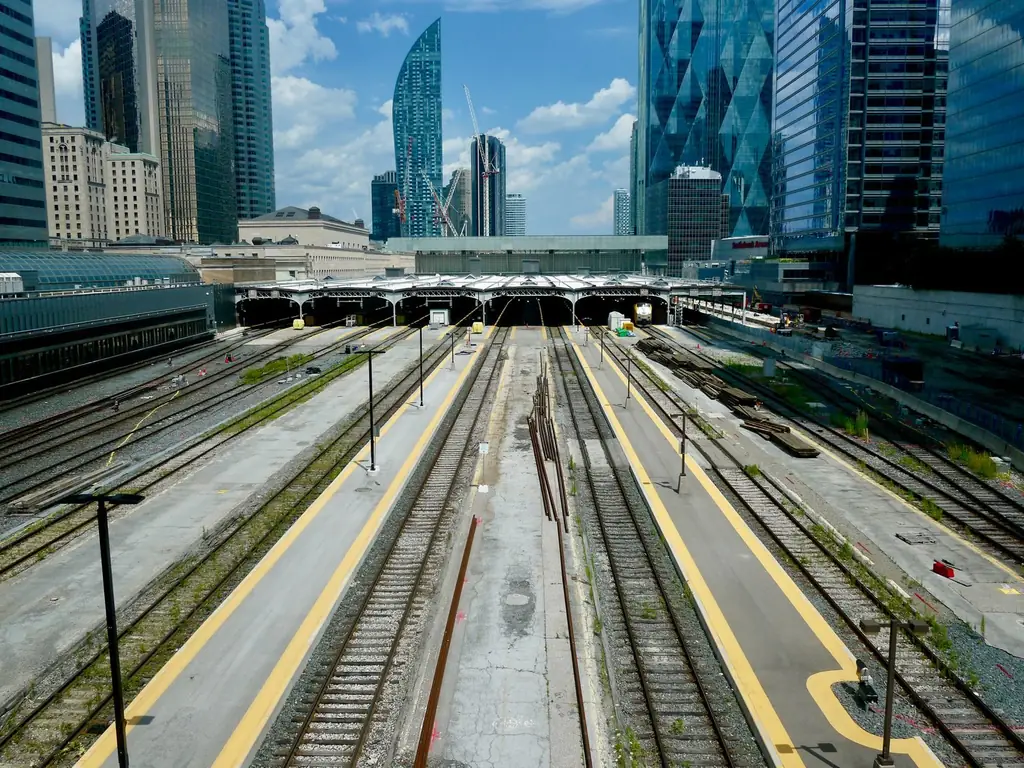
Union Station sits on the south side of the block bounded by Bay and York Streets, at 65 Front Street West, directly across from the Royal York Hotel. The station site lists daily hours of 5:30 a.m. to 12:45 a.m., and VIA Rail's station page lists the same station hours. That is the window in which the building is open, and it covers most scheduled train arrivals.
Booking asks for a few things: your pickup, your drop-off address, the number of passengers and bags, and the train you are on. The train number matters because delays on the corridor do happen, so the arrival time on your ticket is a plan, not a promise. Add it to the booking notes so that dispatch has the scheduled arrival in front of them, and mention if you are travelling with a stroller, a mobility aid or a child seat.
Where the cars stop: Front Street, the Great Hall and York Street
VIA Rail's station page says the curbside pickup and drop-off zone is on Front Street in front of the main entrance, and that taxi stands are in front of the station and on nearby streets. The Great Hall doors are reached from Front Street off the plaza. The Billy Bishop Airport shuttle stops across from the station, outside the Royal York's western entrance on York Street, according to the station's FAQ page.

Two facts help a first-time visitor. There is no parking at Union Station, and there are no public lockers or baggage storage; VIA offers baggage services to its own passengers, with a baggage room open daily from 7:30 a.m. to 7:45 p.m. That means a car that waits at the curb for ten minutes is the opposite of a convenience for the curb itself, and it is the main reason a pickup is coordinated with your actual walk-out time.
When you leave your train, walk toward the Great Hall, collect your bags and message or follow the booking instructions. Do not expect to find a car parked at the platform exit, because the building does not allow it. The pickup point and how you will find the chauffeur are confirmed at booking, and the chauffeur will watch for the train rather than guess.
Union Station Toronto limo distances and drive times
All figures are road distances from Union Station with typical driving times at normal speeds. Toronto traffic moves them, so read the ranges as planning figures, and add time for the 401, the Gardiner Expressway and the Don Valley Parkway at rush hour.
| To | Distance | Typical drive time | Notes |
|---|---|---|---|
| Billy Bishop Airport (mainland terminal) | about 3 km | 10 to 20 minutes | Airport shuttle also stops on York Street |
| Toronto Island ferry terminal | about 1 km | 5 to 10 minutes | Short hop for visitors |
| Pearson Airport (Terminals 1 and 3) | about 33 km | 30 to 50 minutes | UP Express is the alternative |
| Mississauga, Square One area | about 26 km | 30 to 50 minutes | Via the Gardiner and the QEW |
| Markham, Pacific Mall area | about 26 km | 30 to 50 minutes | Via the 404 and the 401 |
| Vaughan Mills area | about 31 km | 35 to 55 minutes | Via the 400 |
| Hamilton, downtown | about 67 km | 55 minutes to 1 h 20 min | QEW corridor |
| Niagara Falls | about 128 km | 1 h 30 min to 2 h | QEW, one of the busiest corridors |
Pearson is the most common long run. At about 33 km and typically 30 to 50 minutes, a car is quicker at off-peak hours and with a lot of luggage. If you want the direct comparison, the UP Express page and the airport guide are the places to start: see Pearson Airport limo service. For Billy Bishop, which is only about 3 km from the station by road, read the Billy Bishop Airport page before you book a car for a trip that short.
Arriving by VIA Rail: how long the train takes
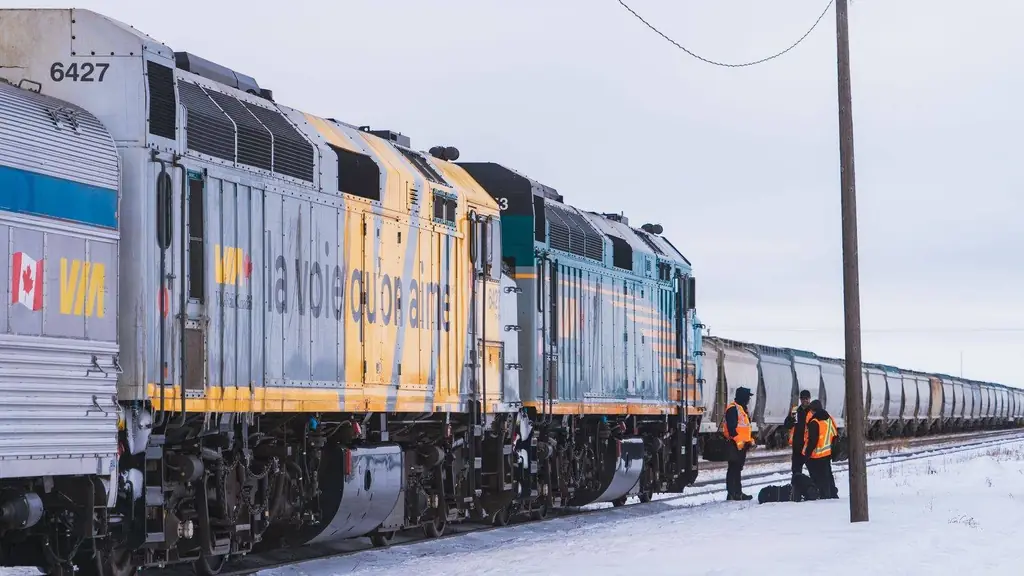
Union Station is where VIA's Ontario Corridor trains meet. VIA's own route pages give the average journey times, and they make useful planning numbers for when your car should be waiting.

| VIA route from Toronto | Distance (VIA) | Average journey | Departures per week |
|---|---|---|---|
| Toronto to Montréal | 538 km | 5 h 13 min | 40 |
| Toronto to Ottawa | 444 km | 4 h 32 min | 54 |
| Toronto to Windsor | 359 km | 4 h 15 min | 28 |
| Toronto to Niagara Falls | 132 km | 2 h | 7 |
Those figures come from VIA Rail's Toronto to Montréal, Ottawa, Windsor and Niagara Falls pages, and they change with the timetable. The road is the real alternative on the same corridor, so compare honestly: the train is calm and work-friendly, and the car is door to door. For a private drive between the cities, see Toronto to Montréal car service and Toronto to Ottawa car service.
The station's own connections: GO, UP Express and the TTC
Union is the point where Toronto's rail and transit systems meet. The station site lists the TTC subway, UP Express, GO Transit and VIA Rail as services, and the station's visitor page describes it as a place that welcomes over 300,000 daily visitors. GO's own page puts Union Station GO at 140 Bay Street, lists connections to the TTC, UP Express and VIA Rail, and notes that free customer parking is not available at this station.
The practical lesson is that Union is a transfer machine, and most of its users are moving between trains and buses, not into cars. If you are travelling into the 905 by GO and your destination is on a GO line, the train is hard to beat for a solo traveller with a light bag. If your destination is a wedding venue, a hotel, a home with children or an address far from a station, a car removes a transfer on each end.
Mind the building's after-hours rule. The western doors on the centre of the plaza, leading into the Great Hall, are unlocked from 5 a.m. to 2 a.m. but only for UP Express users, according to the station's FAQ. Outside the official hours of 5:30 a.m. to 12:45 a.m., you will not be able to wander the concourse. That matters for very late arrivals and very early departures.
Union Station to Pearson: UP Express versus a black car
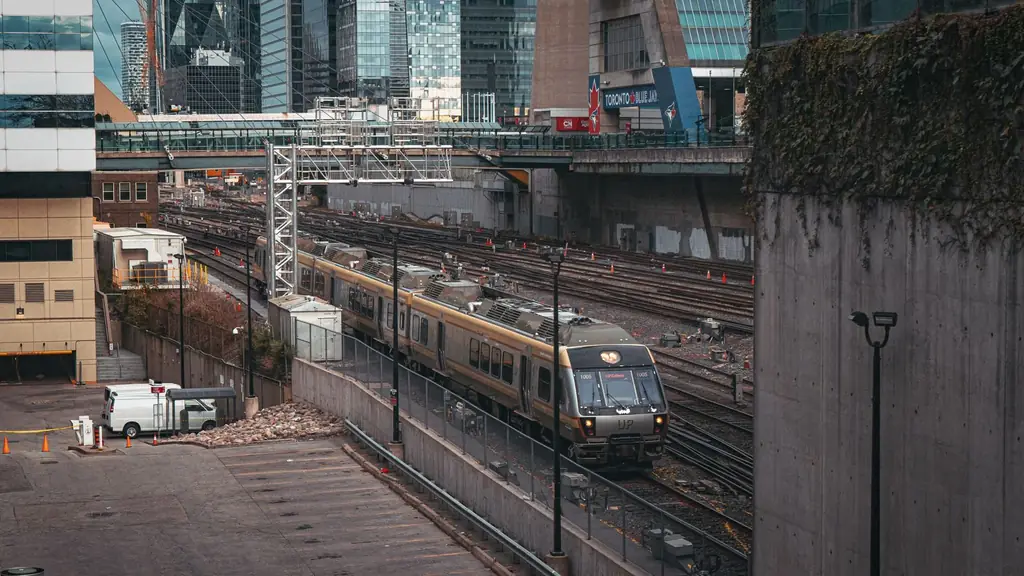
UP Express runs Union to Pearson with stops at Bloor, Mount Dennis and Weston, and the operator advertises a 28-minute journey on its UP Express site. That is faster than the car at most times of day and has no traffic risk. If you are travelling light, alone, with a flexible schedule and a boarding pass, the train is the sensible choice, and we would not try to talk you out of it.

The car earns its place in four situations. First, luggage: a family with several large bags and a stroller does not want to carry them across a platform and then to a terminal. Second, groups: three or more passengers gain from one vehicle and one fare. Third, hours: check the UP Express timetable for first and last departures, because a very early flight may fall outside them and become a car decision. Fourth, comfort and certainty: one pickup, one drop at the right terminal door, no transfers. The booker shows the fixed fare for your address, so you can compare it with the train fare on the UP Express site in a minute.
Pearson has two terminals in regular use. Tell us the airline when you book and we will aim for the correct curb. For the airport side of the trip, Pearson Airport limo service covers terminals and pickup procedures.
Luggage, strollers and child seats from the station
A train arrival is often a luggage arrival, and a long-distance traveller can step off with two cases and a carry-on. An Executive Sedan carries up to three passengers with two large and two carry-on bags, which is usually right for a business traveller. A Luxury SUV carries up to six with five or six large bags, which suits a family. An Executive Sprinter carries 12 to 14 passengers with 12 or more bags and is the answer for a group arriving together.
Child, toddler and booster seats are available when requested at booking, and the chauffeur fits them before the pickup. Tell us the age and weight so the right seat is assigned. See car seat limo service for how that works and the fleet page to compare vehicles.
Corporate and event arrivals through Union Station
Union is the natural arrival point for people coming from Ottawa and Montréal for a meeting on Bay Street, a convention or a festival. If several colleagues are arriving on different trains, a single booking per traveller is cleaner than a shared car that waits for the last one. For a team, ask about corporate car service, which sets out account and invoicing options.
Plan hotel check-in timing honestly. Many downtown hotels do not allow check-in until the afternoon, and an early train lands you before the room is ready. A car does not fix that, but it can take you to a meeting first and the hotel later, with your bags secure on board while you do. If your first stop is a hotel, the Royal York is directly across Front Street, and a booking to it is a short hop.
PATH and getting around the downtown core
Union Station is connected to Toronto's PATH, a network of mostly underground walkways. The City of Toronto's PATH page says it runs more than 30 kilometres, connects more than 75 buildings and gives access to Union Station. For a traveller going to an office tower in the financial district, the walk through PATH can be quicker than any vehicle, particularly in winter, and it is the best answer on a cold day with a short bag.
The reverse is also true. If your destination is outside the PATH, such as a hotel by the waterfront, a residence or a venue in another part of the city, a pickup at the curb is the cleaner way to get there, and it keeps luggage off the escalators. For an itinerary that mixes the two, such as a walk to a meeting and a car for the evening, book the car for the second part only.
Honest comparison: ways to leave Union Station
| Option | Typical time to Pearson (33 km) | Cost note | Best for |
|---|---|---|---|
| Private chauffeur (booked here) | 30 to 50 minutes | Fixed fare via booker | Groups, luggage, early flights, certainty |
| UP Express | 28 minutes (operator figure) | Fixed train fare, published by the operator | Solo travellers with light bags |
| GO Transit and local transit | Several transfers | Low | Commuting to the 905 on a GO line |
| TTC subway and bus | Longer, with transfers | Lowest | Budget travel with light luggage |
| Taxi from the rank | 30 to 50 minutes | Meter-based | Unplanned arrivals |
| Rideshare | 30 to 50 minutes | Meter plus surge | Spontaneous trips with a phone signal |
| Walk or PATH | Not applicable | Free | Downtown offices and hotels within reach |
The table is meant to be used. If the destination is a downtown office tower and your bag fits on one arm, walk. If the destination is a train line, ride it. If the destination is a venue, a family home or a flight at an awkward hour, the car is the better answer. We would rather you take the right option than tick the wrong box.
How to book, cancel and what the chauffeur does
Booking is online. Enter the pickup, drop-off, passengers, bags and train number, and the booker shows the exact all-in fare for your address and vehicle before you pay. Vehicles and chauffeurs are licensed and commercially insured, and dispatch runs around the clock.
If plans change, more than 72 hours' notice carries no charge. At 72 hours or less the charge is 10%, at 48 hours or less it is 50%, and at 24 hours or less or a no-show it is 100%, all measured from the scheduled pickup time. For other rail arrivals, see our train station guide and the Montréal Central Station page. For a broader view of what we offer in the city, see limo service Toronto.
Frequently asked questions
How much is a limo from Union Station to Pearson Airport?
Union Station to Pearson is about 33 km and typically 30 to 50 minutes. The booker shows the exact all-in fare for your terminal and vehicle before you pay, so you can compare it with UP Express on the operator's site.
Where do I meet my chauffeur at Union Station?
The station's curbside zone is on Front Street in front of the main entrance, and the Great Hall is reached from the plaza. The exact meeting point is confirmed at booking, so you will have it before your train arrives.
Is there parking at Union Station?
No. The station says there is no parking at Union Station, and there are no public lockers or baggage storage. VIA Rail offers baggage services to its own passengers. A booked pickup avoids the parking problem entirely.
How long is the train from Toronto to Montréal and Ottawa?
VIA lists an average of 5 h 13 min for Toronto to Montréal and 4 h 32 min for Toronto to Ottawa. Times vary by train and day, so check the timetable for your own departure.
When is UP Express better than a car to Pearson?
For a solo traveller with light bags, UP Express is a good choice, and the operator advertises 28 minutes. A car is better for groups, large luggage and flights outside the train's published hours.
Can you take me from Union Station to Billy Bishop Airport?
Yes. The mainland terminal is about 3 km away, typically 10 to 20 minutes. The airport shuttle also stops on York Street, and for a short trip with light bags it may be enough.
Can I add a child seat to a Union Station pickup?
Yes. Child, toddler and booster seats are provided when requested at booking. Give us the child's age and weight so the correct seat is fitted before you arrive.
What if my train is late?
Delays on the corridor can happen. Add your train number to the booking notes so that the scheduled arrival is on record, and tell us if the arrival time changes materially. Cancellation terms are measured from the scheduled pickup time.